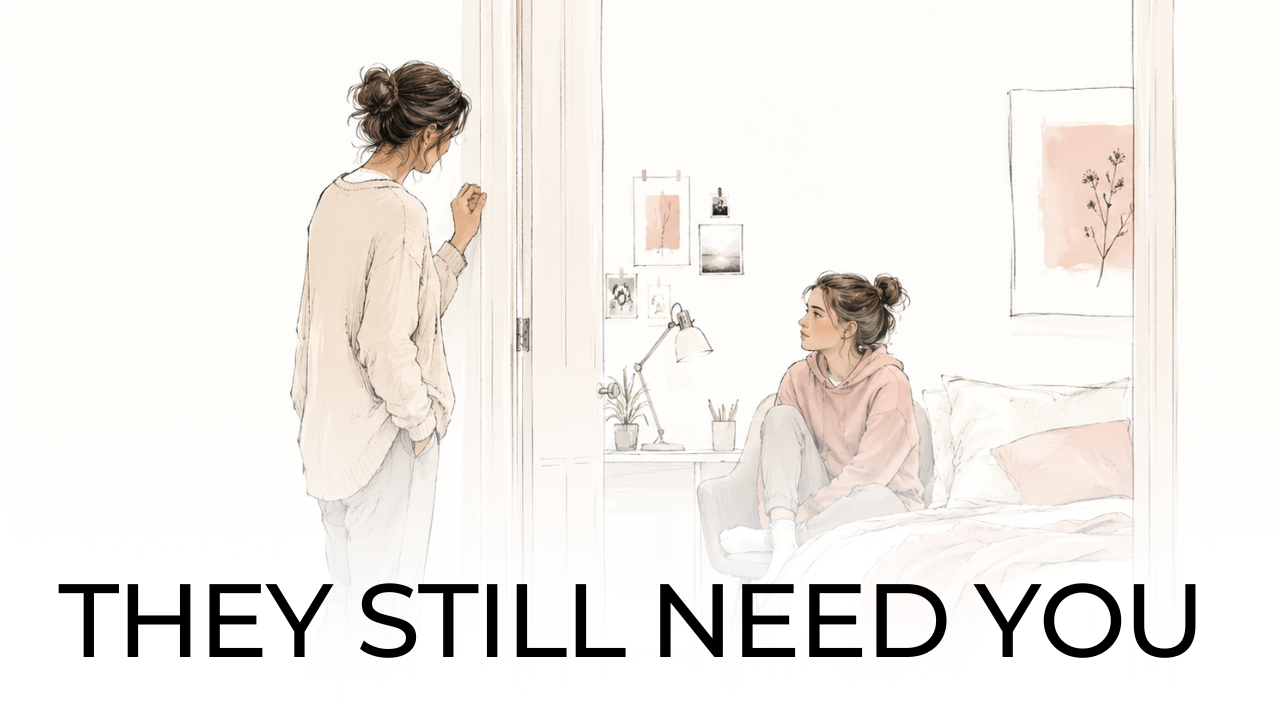
When your teen starts to pull away
I’m writing to you today with a big, open, broken, beautiful heart to remind you to trust the process when your kids start to pull away.
Yes, it’s easier said than done. But trust that distance is not a crisis. It’s natural and necessary.
To all the parents out there who are experiencing real, true differentiation from their kids right now, I see you. And I’m not talking about the dramatic kind of differentiation, but rather the quiet kind. That legitimate distance that just comes with them growing up. The kind that hits you right in the core.
Appropriate? Yes.
Heartbreaking? Also yes.
Normal? 100%.
But even though we can logically know that this is supposed to happen, it doesn’t ease the discomfort when it does happen.

Maybe you’re feeling that first uncomfortable taste of distance as your child enters the early tween or teen years and starts to feel embarrassed by you or they don’t want to hold your hand in public.
Or maybe you’re more in the thick of it. Perhaps you have a college student who doesn’t check in as much as you’d like. Or a child who shares less than they used to. Or possibly, a child who shares plenty with you, but you’re not quite sure how to respond anymore because you’re both so different than you once were.
For me, I’m feeing it as my older daughter prepares to leave. I can feel her craving more emotional space and building her healthy boundaries. Ironically, I’ve been encouraging her to do just this her entire life, and yet… why does it feel so awful now that it’s happening?
A wise friend a few years ahead of me said to me this morning:
It’s just hard. No more to say.
So, what can we do when our kids feel really far away? Oh, how I wish I had a clean answer for that.
For me, I’m doing my best to simply feel it.
I intentionally notice the discomfort in my body, I sit with it, and I do my best to remind myself that it’s supposed to feel like this. If it didn’t, it wouldn’t mean so much. We feel hard things because we love deeply.
Let me say that again: We feel hard things because we love deeply.
What a gift that is, even when it’s profoundly uncomfortable. Remember in these moments that it all does matter. Our role as parents still matters, even when it shifts in these heartbreaking ways. And remember that these feelings will come and go, as they do. For me, as long as I don’t attach a catastrophic story to them, they move. And in a few minutes, hours, or days, I find myself trusting the process again. I feel that freedom again.
Also remember that the art of listening is a daily practice. Even when your child is distancing themself, do your part to keep that emotional door open. I have to remind myself of this constantly. How can I listen while still being authentic, while not sounding robotic, while not giving advice too quickly, and while staying grounded, and all while they’re pushing me away?? What the fuck… It’s asking a lot!!
So, we practice. We try. We mess it up. We try again.
Our kids are also practicing and trying and messing up. They’re learning how to become independent humans, and as we all know, being human isn’t easy. For them. For us. For anyone.
And while I can sit here and tell you it’s all completely normal, and give general advice on how to get through it, the feelings this parenting phase can stir up are deeply personal and unique for each of us individually.
This is where a one-on-one session with me can really serve you. Because this phase offers a beautiful invitation for self-discovery, curiosity, and self-compassion. An opportunity to explore what’s unresolved and being activated within you, so you can better trust the process, and continue showing up for your child on their own evolving life journey.
Keep showing up. Keep listening. Keep trusting. Rinse and repeat.
This is the sacred mess of growing and letting go.
With love and respect,
Deb
PS: I am taking new Therapeutic Parent Coaching Clients for 1:1 sessions (all parents of all genders!) Virtual & In Person.